The administrative side of healthcare is shifting away from traditional paper slips toward electronic verification systems. When you get sick, injured, or require an extended period of rest, the paperwork you submit to your employer or school matters just as much as your physical recovery. Modern human resources departments and academic institutions no longer accept vague handwritten notes that lack verifiable data. Understanding the standards of digital medical documentation ensures that you can protect your job, your education, and your financial investments during a health emergency.
This extensive guide will break down the entire framework of virtual healthcare verification records used across different industries. You will learn the specific legal differences between a simple daily excuse, an extended job-protected leave form, and specialised documents used for housing or travel. By understanding what human resources managers and insurance adjusters look for, you can avoid common submission errors. Having access to a legitimate online doctor’s note from a board-certified physician allows you to manage these professional responsibilities from the safety of your home.
Part 1: The Spectrum of Verification in the Modern Office
Every absence from work requires a different level of justification depending on the length of time you are away and the severity of your condition. Many employees make the mistake of using a basic sick note for an extended medical issue, which can lead to denied claims or unexcused absences. You must understand how corporate human resources departments classify these documents to ensure your paperwork matches your actual situation.
Short-Term Illness Verification and Daily Absences
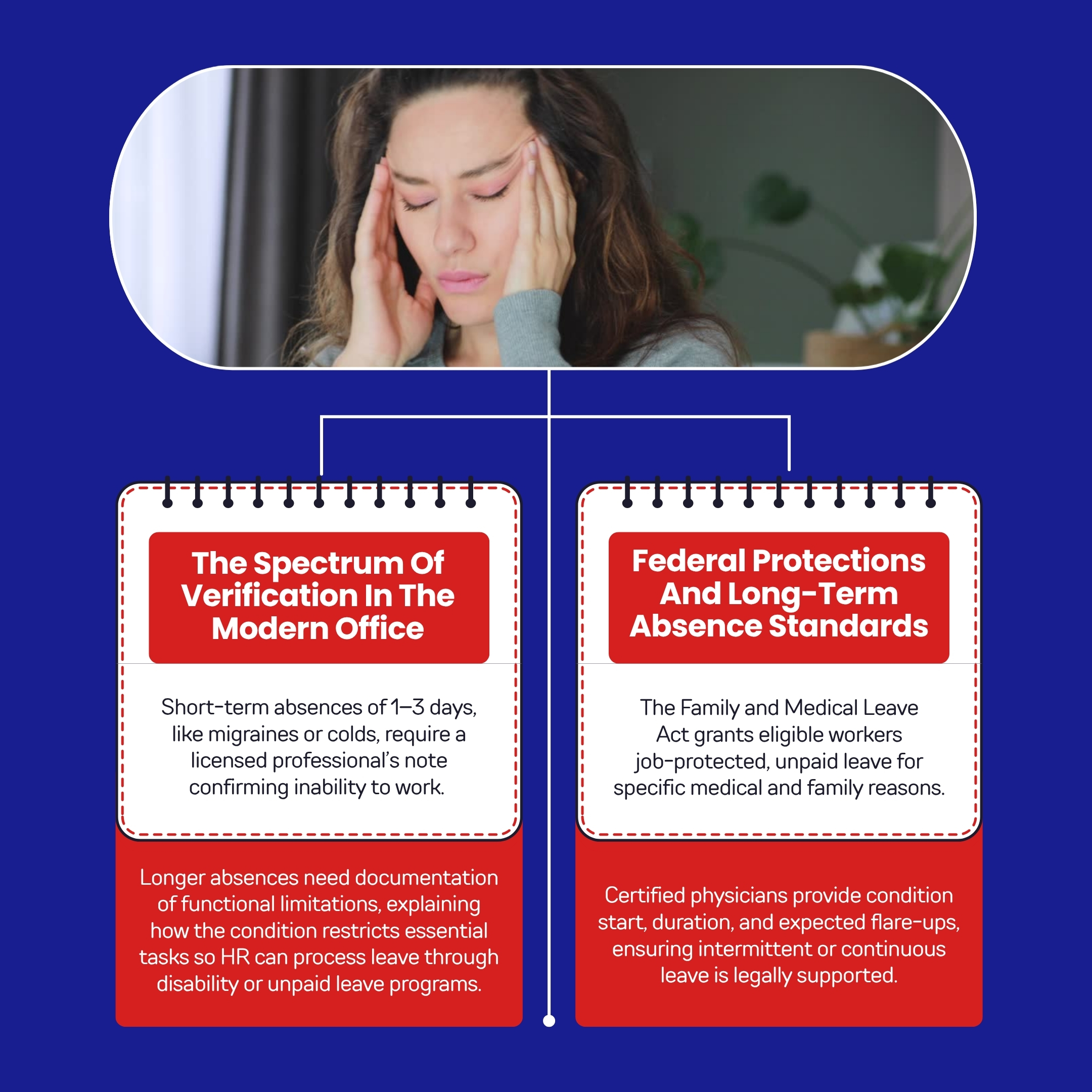
Short-term verification covers sudden, temporary illnesses that pass within one to three business days, such as food poisoning, a migraine, or a severe seasonal cold. For these brief absences, employers typically require a straightforward statement from a licensed professional confirming that you were medically unable to perform your work duties on specific dates. The purpose of this document is to justify your immediate absence and protect you from punitive attendance points or salary deductions.
A proper short-term excuse must contain the date of your medical evaluation, the specific dates you are excused from work, and the official contact details of the medical practice. It does not need to reveal your exact diagnosis or private symptom history, as this information is protected under privacy laws. Instead, it serves as an official confirmation that a qualified physician reviewed your state of health and determined that rest was necessary for your recovery.
The Problem of In-Person Access for Minor Ailments
When you are suffering from an acute condition like a high fever or stomach flu, traveling to a traditional doctor’s office is often counterproductive. Sitting in a crowded clinic waiting room for hours exposes you to other pathogens and drains the energy your body needs to fight off the infection. Furthermore, many primary care clinics cannot accommodate same-day appointments, leaving you without options when you need immediate documentation for your supervisor.
This logistical barrier is the primary reason why virtual medical platforms have become a necessity for modern workers. You can report your symptoms through a secure digital intake form and receive a verified clinical review without leaving your bed. This quick turnaround ensures that you can notify your employer with official proof on the first day of your illness, establishing immediate transparency and preventing disciplinary actions.
Extended Leave and Job-Protected Certifications
When an illness or injury keeps you away from work for more than a few days, short-term notes are no longer sufficient. If your condition requires continuous treatment or a recovery period that lasts weeks or months, you must transition to long-term leave documentation. This type of paperwork falls under different corporate and federal guidelines designed to protect your position while you are unable to fulfill your regular job descriptions.
Extended leave records require a deeper look at your functional limitations rather than just a statement that you are sick. The documenting physician must explain how your condition restricts your ability to perform your essential job tasks, such as lifting objects, sitting for long periods, or looking at computer screens. Providing this detailed information allows your human resources department to process your extended absence through their formal short-term disability or unpaid leave programs correctly.
Part 2: Federal Protections and Long-Term Absence Standards
For serious health conditions that require extended time away from work, employees must rely on federal frameworks to protect their employment status. The most common framework used in the United States is the Family and Medical Leave Act, which grants eligible workers job-protected, unpaid leave for specific medical and family reasons.
Understanding the Requirements of Federal Medical Leave
Securing protection under federal law involves a rigid administrative process that requires highly specific clinical data. A Family and Medical Leave Act certification must be filled out by a licensed healthcare provider to prove that you or an immediate family member is suffering from a serious health condition. A serious condition is defined as an illness, injury, or physical state that involves inpatient care or continuing treatment by a health professional.
The forms require the doctor to state the date the condition commenced, the probable duration of the issue, and the medical facts regarding the health event. These medical facts must describe the impact of the condition on your daily activities without violating your right to fundamental diagnostic privacy. If the form is incomplete or lacks clear clinical justifications, your employer has the legal right to deny your leave request, leaving your job unprotected.
Intermittent Leave Certification and Chronic Conditions
Not all serious health conditions require a continuous block of time away from the office. Many chronic illnesses, such as severe asthma, epilepsy, migraines, or clinical depression, involve episodic flare-ups that cause unpredictable absences. For these situations, physicians can issue documentation for intermittent leave, allowing you to take hours or days off as needed without risking your employment status.
The documentation for intermittent leave must estimate the frequency and duration of these expected episodes based on your clinical history. For example, the doctor might state that your condition is likely to cause two flare-ups per month, requiring one to two days of rest per episode. This forecast allows your human resources department to plan around your absences while ensuring that each sudden departure is automatically protected under federal guidelines.
The Role of Specialized Doctors in Federal Paperwork
Completing complex federal forms requires a physician who understands the intersection of clinical diagnoses and workplace law. Many traditional primary care doctors are hesitant to fill out these extensive packets because of the time required to complete them during a standard fifteen-minute office visit. This hesitation can leave you stranded when your company’s human resources department sets a strict fifteen-day deadline for the submission of your paperwork.
Specialized virtual medical platforms employ physicians who are trained to handle these administrative requirements efficiently. They review your medical records, assess your current functional limitations, and complete the necessary federal forms with the precise medical language required by corporate legal teams. This professional service ensures that your application is processed accurately on the first attempt, removing the anxiety of potential job loss during a health crisis.
Part 3: Academic Standards and Educational Absence Records
The need for official medical verification is not limited to corporate offices; educational institutions also maintain strict attendance policies that impact your academic standing. Missing an exam, a laboratory session, or a major assignment deadline without an official excuse can result in a failing grade or academic probation.
University and School Attendance Policies
Universities and secondary schools have established rigid guidelines to manage student absences and ensure academic integrity. A student cannot simply send an email stating they are unwell; they must provide a formal document from a verified medical practice to justify their absence from mandatory academic events. These policies are designed to prevent students from fabricating illnesses to gain extra study time or avoid difficult assessments.
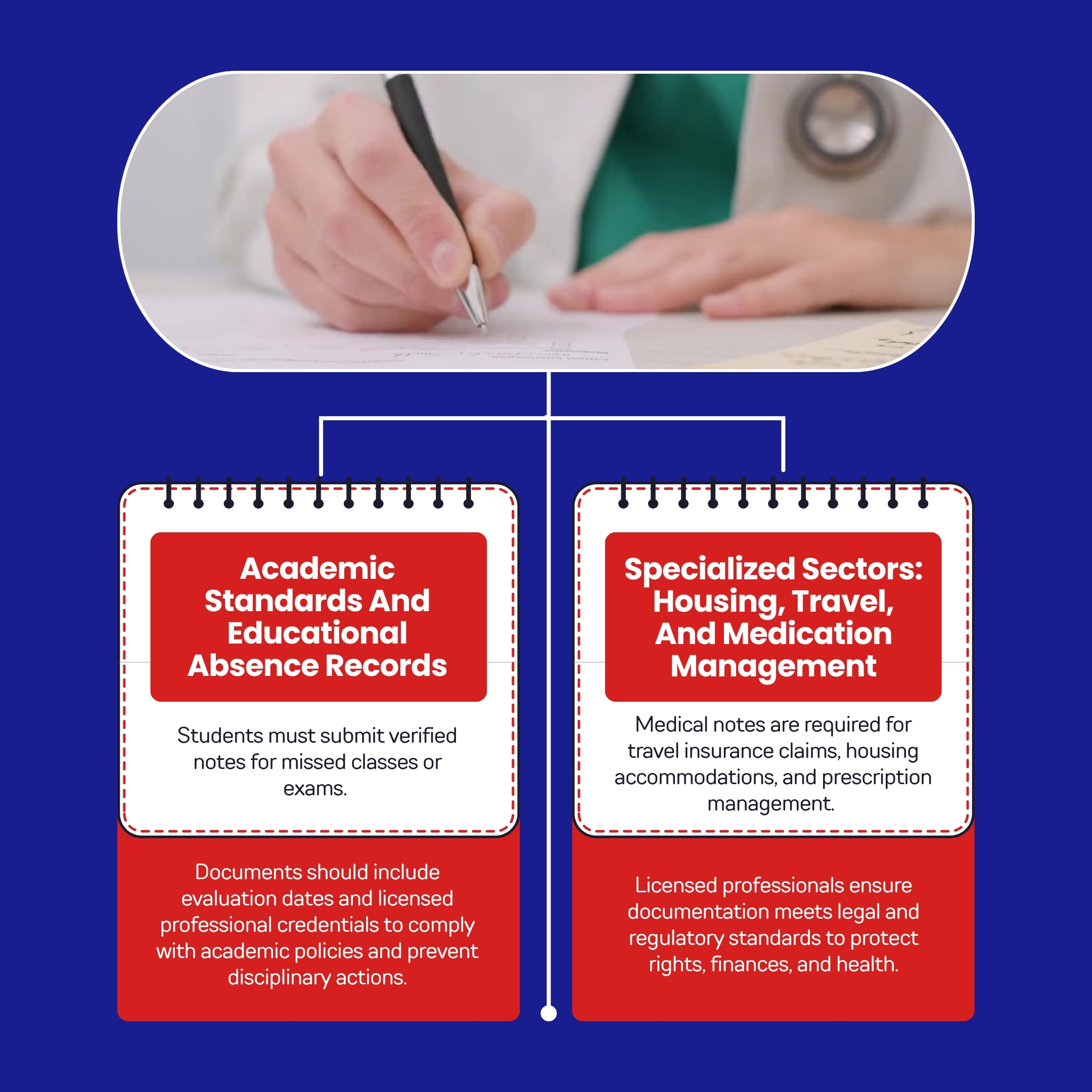
An academic medical excuse must explicitly cover the date of the missed class or examination and state that the student was physically or mentally incapable of participating in school activities. It must be issued by a licensed professional who evaluated the student during the acute phase of their illness. Academic departments frequently contact the issuing medical office to verify that the document is authentic and that the student was a registered patient on that specific day.
The Risk of Using Unverified Absence Notes
Many students turn to unverified online sources or templates when they need an immediate excuse for a missed class, which is a highly risky decision. Educational institutions have become experts at spotting fraudulent documents, and submitting an unverified note can lead to severe disciplinary actions under the school’s academic honor code. These consequences can include suspension, permanent expulsion, or a permanent mark of dishonesty on your academic transcript.
To avoid these risks, you must ensure that any digital excuse you submit comes from a platform that utilizes real, licensed medical professionals. The document must contain verifiable credentials, such as the doctor’s state license number and a clear method for the school to contact the clinic for confirmation. Using a legitimate service protects your academic career and ensures that your health issues are respected by the faculty.
Balancing Academic Pressure and Physical Recovery
The pressure to maintain high grades often drives students to attend classes while suffering from contagious infections like mononucleosis, influenza, or strep throat. This behavior not only slows down the individual student’s recovery but also endangers the health of the entire campus community. Providing an efficient path to digital medical documentation encourages students to make the responsible choice to stay in their dorms and rest.
Virtual healthcare services allow students to receive a professional evaluation without having to navigate campus transport or walk to a campus health clinic while weak. The resulting digital document gives the student the leverage they need to request makeup exams or assignment extensions from their professors. This professional support ensures that a temporary health issue does not derail a student’s long-term educational goals.
Part 4: Specialized Sectors: Housing, Travel, and Medication Management
Beyond work and school, digital medical records play a major role in protecting your consumer rights and managing long-term health treatments. The travel industry, housing sectors, and prescription systems each have their own specific documentation requirements that you must follow to avoid financial or logistical setbacks.
Travel Cancellation Insurance and Medical Justifications
Booking a vacation involves significant financial risk, as flights, hotel reservations, and tour bookings are often completely non-refundable. If a sudden illness or medical emergency prevents you from traveling, you must file a claim with your travel insurance provider to recover your expenses. Insurance companies will not approve a reimbursement based on a personal statement; they require objective medical evidence from a physician.
A travel cancellation document must state that the physician evaluated you before the scheduled departure and determined that travel was medically unsafe. The language used must be clear and direct, linking your specific symptoms or diagnosis to the physical demands of travel, such as flying or long-distance transit. Having this verified documentation is the only way to bypass standard cancellation penalties and secure a full financial reimbursement from your insurer.
Emotional Support Animals and Fair Housing Regulations
The housing sector is another area where medical documentation is legally required to secure your rights as a tenant. Under the Fair Housing Act, individuals with mental health conditions or emotional disabilities have the right to keep an Emotional Support Animal in their residence, even in buildings that maintain strict “no-pets” policies. To access this legal protection, you must provide your landlord with an official letter from a licensed mental health professional or physician.
An official letter for an emotional support animal must be written on the provider’s professional letterhead and include their license type, issuance date, and the state where they are certified to practice. The letter must state that you are under their professional care and that your animal provides a necessary therapeutic benefit that alleviates symptoms of your diagnosed condition. Landlords have the right to verify these credentials, so using a service backed by real, licensed doctors is essential to ensure your letter holds up under scrutiny.
Medication Management and Asynchronous Refill Records
Managing long-term maintenance medications for chronic conditions like high blood pressure, cholesterol, or thyroid issues requires ongoing medical supervision. Traditionally, patients had to schedule an in-person doctor’s visit every month or two just to secure a renewal of their routine prescriptions. This requirement creates unnecessary stress and financial strain for individuals who are stable on their current treatment plans.
Modern telemedicine has streamlined this process by dividing medication management into distinct clinical pathways based on safety and duration:
| Refill Type | Assessment Method | Live Call Requirement | Clinical Purpose |
| 30-Day Refill | Asynchronous Review | No Phone or Video Call | Quick renewal for stable patients with short-term needs. |
| 90-Day Refill | Asynchronous Review | No Phone or Video Call | Extended supply for long-term maintenance medications. |
| 1-Year Refill | Synchronous Evaluation | Mandatory Video Visit | Comprehensive annual check-up to assess long-term safety. |
This tiered system ensures that patients can access shorter maintenance refills through a fast, asynchronous digital form while reserving live video interactions for thorough annual reviews. This maximizes clinical efficiency while maintaining patient safety.
Part 5: The Legal and Clinical Integrity of Digital Medical Records
The widespread acceptance of digital health records depends entirely on the legal and clinical frameworks that ensure their validity. As more industries transition away from physical paperwork, the systems used to generate and verify medical documentation must meet strict federal and state guidelines.
HIPAA Compliance and Patient Data Security
Any platform that handles your medical records must operate under the strict guidelines of the Health Insurance Portability and Accountability Act. HIPAA regulations dictate how your personal health information is collected, transmitted, and stored in the digital space. Legitimate virtual health services use high-level encryption protocols to ensure that your symptoms, intake forms, and final medical letters remain completely confidential.
When you submit a digital note to your employer or school, they only have the right to see the final document you provide; they do not have access to the secure portal where your medical history is recorded. This clear boundary protects your right to privacy while still satisfying the administrative needs of your company or educational institution. Working with a platform that prioritizes data security ensures that your private health information never falls into the wrong hands.
The Role of National Provider Identifier Verification
The primary tool used by human resources departments and insurance adjusters to verify a medical note is the National Provider Identifier database. The NPI is a unique identification number issued to individual healthcare providers by the federal government to ensure standardisation and prevent fraud. Every genuine digital medical document must include the signing doctor’s NPI number clearly printed alongside their name and professional signature.
When an administrative official receives your note, they can input this ten-digit number into the public national registry to verify that the physician is licensed and in good standing. If a note lacks an NPI number, or if the number links to an unverified individual, the document will be rejected instantly as a fraudulent record. Ensuring that your digital health platform uses registered, board-certified professionals is the most important step in protecting your professional reputation.
State Licensure and Jurisdictional Healthcare Rules
Medical licenses are issued on a state-by-state basis, and healthcare professionals must be registered to practice in the specific state where the patient is located at the time of the evaluation. This jurisdictional rule applies to virtual medicine just as it does to traditional walk-in clinics. A digital medical excuse is only legally binding if the signing physician holds a valid license in your home state or the state where your workplace operates.
Legitimate online health services maintain a network of doctors certified across different jurisdictions to ensure compliance with these local laws. When you fill out an online intake form, the platform automatically routes your case to a physician who is legally authorized to practice in your specific location. This attention to legal detail ensures that your documentation is valid under local regulations and will withstand any formal audit by your employer’s legal team.
Establishing Your Workplace Protections Effectively
Managing an unexpected health event requires your full attention, and you should not have to sacrifice your recovery time to navigate complex administrative hurdles. The shift toward verified digital documentation has made it possible for workers, students, and travelers to protect their interests from home. By understanding the specific requirements of your human resources department or insurance company, you can present a documented case that satisfies every corporate standard.
We understand how stressful it can be to secure professional verification when you are feeling physically or mentally exhausted. Our team focuses on providing authentic, physician-signed documentation that protects your career and matches modern corporate standards. Whether you need a short-term excuse or a long-term medical certificate for leave to justify an extended recovery period, we ensure your files are processed by licensed professionals.
If you need a reliable, verified document to protect your job or education during an unexpected health emergency, we invite you to use My Dr’s Note. We help you obtain a real doctor’s note for work or school through a secure digital intake process that eliminates the long waits of traditional clinics. Let our network of board-certified physicians handle your administrative needs so you can focus entirely on your health. Secure your official online doctor’s note for work today and rest with complete peace of mind.
Contact us at 1-737-307-1026 to find out more.