
The relationship between corporate attendance policies and medical justification has shifted significantly as virtual care becomes a standard component of modern medicine. In the past, human resources departments required physical paperwork stamped by a local clinic to excuse an employee’s absence or approve a leave request. Today, organizations are updating their internal frameworks to accommodate the reality of remote healthcare services. Understanding the precise standards of workplace medical documentation allows you to manage health challenges without jeopardising your job security or professional reputation.
This shifts the administrative burden onto modern validation methods, where digital security features replace traditional hand-signed forms. When you are too ill to perform your job duties, the process of securing a real doctor’s note for work should not force you to leave your home or stand in a crowded clinic line. By understanding what your human resources department legally requires, you can leverage digital health platforms to provide compliant, professional records that protect your employment rights.
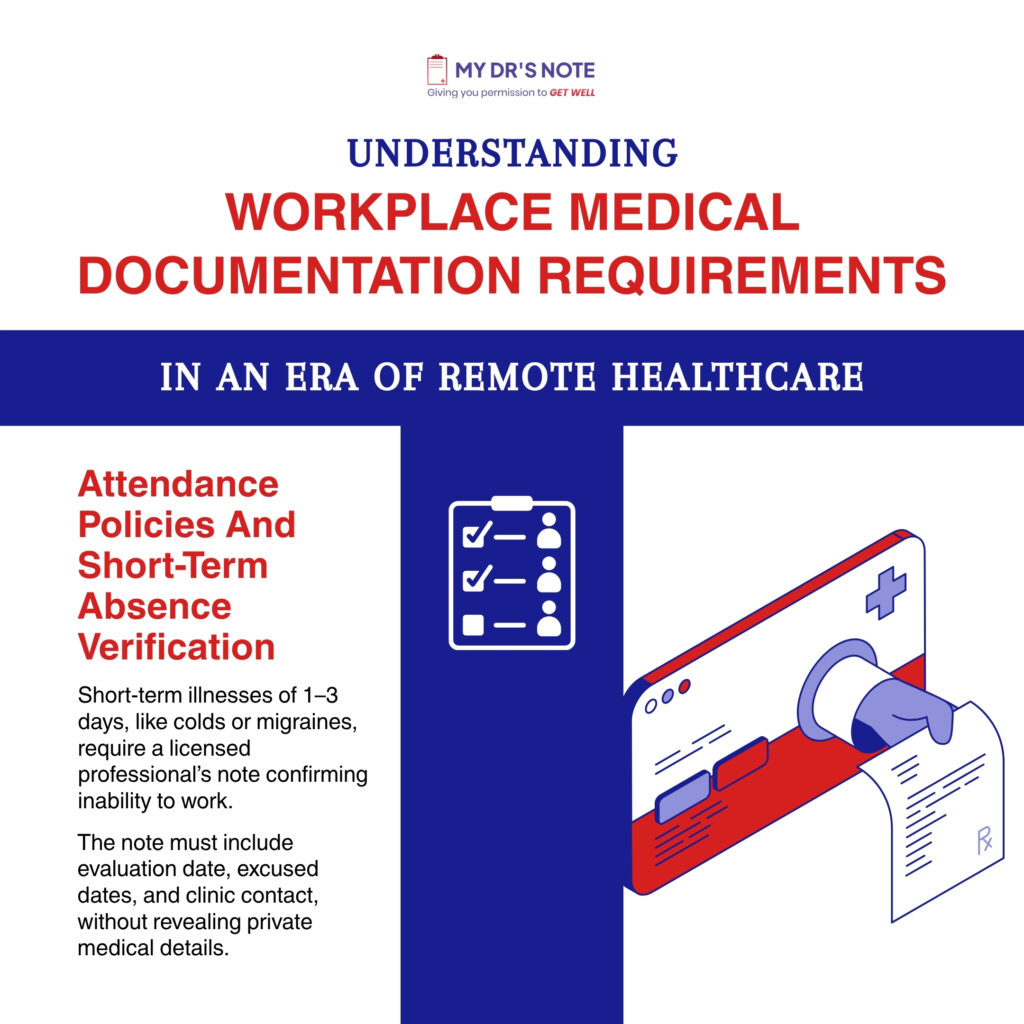
Attendance Policies and Short-Term Absence Verification
Every business infrastructure maintains specific rules regarding unplanned absences to keep their operations running smoothly. For short-term illnesses lasting between one and three consecutive days, companies typically rely on standard medical excuses to distinguish between unauthorized absenteeism and legitimate health events.
The Purpose of Daily Excuses in Corporate Environments
A short-term medical excuse functions as a formal document that records a professional health assessment on a specific date. Human resources teams use these records to verify that your absence was a necessity rather than a personal choice. This documentation protects you from receiving punitive marks on your attendance record, which can accumulate and lead to formal performance reviews or termination.
The paperwork must include the provider’s office details, the date of your assessment, and a clear statement indicating the exact timeframe you are excused from work duties. It is important to know that these short-term notes do not need to contain private details regarding your specific symptoms or diagnoses. Privacy regulations prevent employers from demanding extensive medical histories for routine illnesses like food poisoning, a severe migraine, or acute seasonal infections.
Challenges of Accessing Quick Clinical Assessments
When you are suffering from acute symptoms such as severe fatigue, fever, or gastrointestinal distress, traveling to a medical facility is often physically difficult. Traditional primary care offices often operate with packed schedules, meaning you might have to wait weeks for an open appointment slot. If your company policy dictates that you must submit a medical note within twenty-four hours of your absence, these clinic delays create an immediate professional crisis.
This accessibility gap is the main reason why employees turn to virtual medical platforms during a sudden illness. Instead of spending hours in transit or waiting rooms while highly contagious, you can submit your symptoms through a secure online portal. A board-certified physician can review your data asynchronously or via a video call, providing the official documentation you need on the exact day you are sick. This immediate availability keeps you fully compliant with corporate notification deadlines.
The Administrative Burden of Point-Based Attendance Systems
Many corporate environments utilize point-based attendance tracking systems to manage employee dependability. Under these strict frameworks, every unexcused absence assigns a negative point or strike to your profile. Accumulating a specific number of these points within a rolling six-month or twelve-month period triggers automatic disciplinary actions, ranging from formal written warnings to immediate suspension.
A verified medical document is the only administrative mechanism available to eliminate these points. When a human resources representative processes an official certificate signed by a licensed physician, the absence is coded as excused in the payroll and time-tracking software. This administrative correction resets your status and protects your career longevity from automated corporate policy triggers.
Addressing the Financial Impact of Unexcused Time Off
Beyond the threat of disciplinary points, unexcused absences can have an immediate negative impact on your paycheck. For hourly workers and salaried employees without an extensive bank of paid time off, an unexcused day means a complete loss of wages for that period. Some corporate policies even state that if an absence falls immediately before or after a paid company holiday, you lose your holiday pay as well unless you provide valid medical proof.
Submitting a digital excuse immediately ensures that your time away is correctly categorized under your company’s sick leave policy. This guarantees that your compensation remains stable while you take the time to rest and fight off an illness. By handling this documentation through an efficient online platform, you eliminate the risk of lost wages and maintain your financial stability during an unexpected health emergency.
Federal Leave Regulations and Job-Protected Status
When a short-term illness evolves into a long-term medical challenge, or when a chronic health condition flares up repeatedly, standard sick notes are no longer sufficient. At this stage, employees must transition to formal federal leave frameworks to guarantee their position will be saved while they focus on recovery.
The Framework of the Family and Medical Leave Act
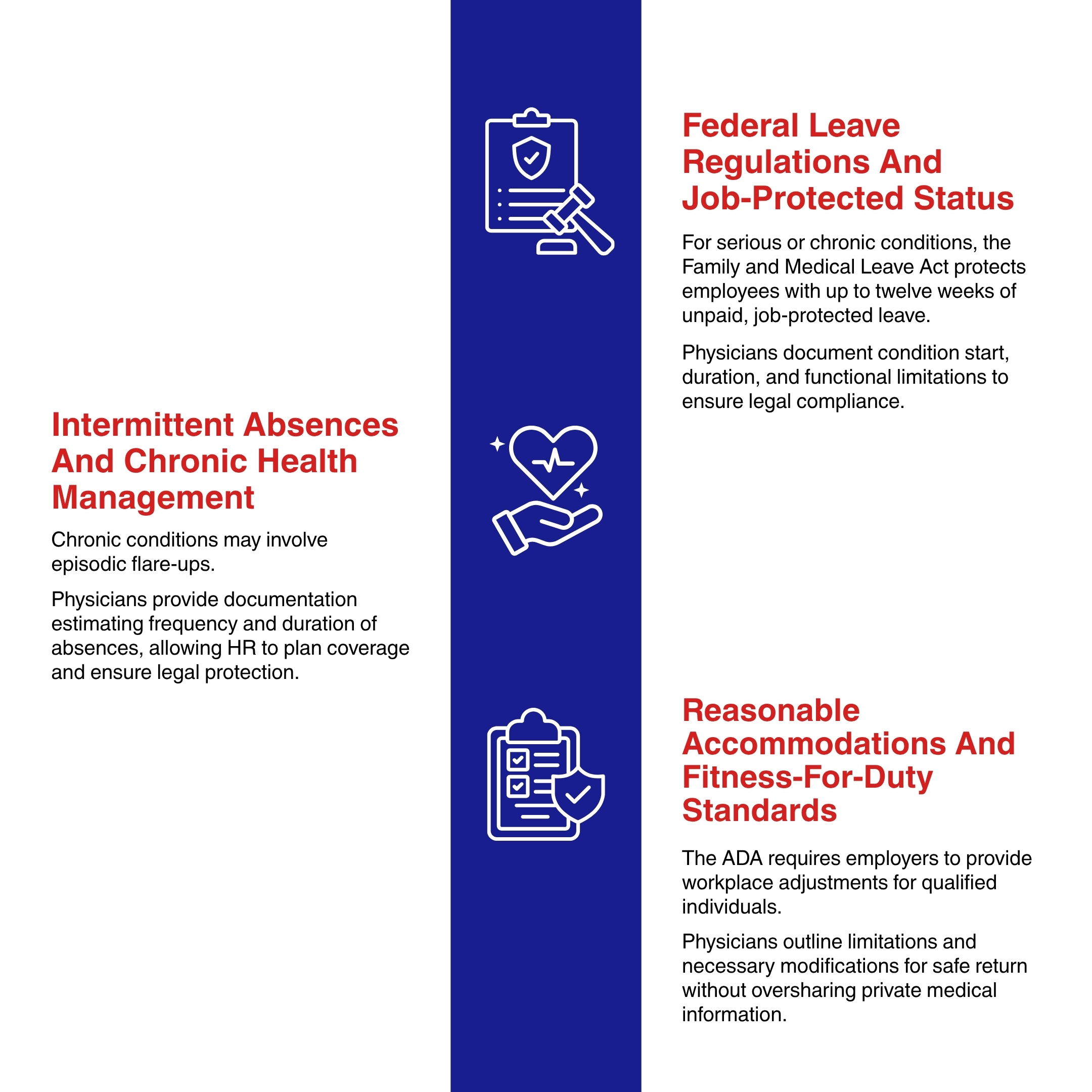
The Family and Medical Leave Act provides eligible workers with up to twelve weeks of unpaid, job-protected leave per year for specified medical and family reasons. To qualify for this protection, you must have a serious health condition that prevents you from performing the essential functions of your job. Your employer has the legal right to require a formal Family and Medical Leave Act certification completed by a licensed healthcare professional to verify this status.
This certification package requires the documenting physician to provide specific clinical facts regarding your condition, its expected duration, and the date it commenced. The doctor must outline your functional limitations—such as your inability to sit, stand, lift objects, or use a computer screen—to show exactly why you cannot complete your regular work tasks. If you fail to return this completed packet within the standard fifteen-day window set by HR, your employer can deny your leave protection entirely.
Intermittent Absences and Chronic Health Management
Not all long-term health issues require you to take weeks off in a single consecutive block. Many chronic conditions, such as severe respiratory issues, autoimmune disorders, or clinical mental health challenges, manifest as unpredictable flare-ups. In these cases, your physician can draft an intermittent leave certification that allows you to take partial days or isolated days off whenever your symptoms peak.
The medical paperwork for intermittent leave must include an expert estimate of how often these episodes will occur and how long each one will last. For instance, the doctor might specify that your condition is likely to cause three flare-ups per month, with each episode requiring forty-eight hours of complete bed rest. This structured projection allows your company to arrange coverage for your sudden absences while ensuring that each instance is legally protected from corporate retaliation.
Completing Complex Federal Paperwork Digitally
Filling out extensive federal leave forms requires a detailed understanding of both medical terminology and employment law guidelines. Many primary care physicians find these packets burdensome and may delay completing them due to the high volume of patients they see daily in physical clinics. This delay puts you at risk of missing the corporate submission deadline, causing unnecessary stress during a health emergency.
Digital healthcare services address this issue by employing physicians who specialize in medical-administrative documentation. These virtual professionals can review your comprehensive medical history, assess your current health status through secure digital platforms, and complete your federal forms with precision. The resulting documents use the exact professional language that corporate human resources departments require, reducing the likelihood of your application being rejected or delayed for administrative updates.
Navigating the Employer Review and Clarification Period
Once you submit your federal leave certification to your employer, their human resources team has the right to review the document for completeness and authenticity. If the forms contain vague statements or missing sections, the company cannot deny your request immediately; instead, they must provide you with a written notice stating exactly what additional information is required. You then have seven calendar days to correct the deficiencies with your doctor.
During this review period, having direct access to an online medical provider is incredibly valuable. Instead of waiting weeks to book a follow-up appointment at a traditional clinic just to fix a single line on a form, you can communicate with a digital platform immediately. The physician can quickly provide the necessary clarifications or additional clinical details required by your employer, ensuring your job protection is finalized without administrative delays.
Understanding Second and Third Medical Opinions
Under federal leave guidelines, if an employer has a legitimate reason to doubt the validity of your initial medical certification, they can require you to obtain a second medical opinion. The company must pay for this second evaluation, and they get to choose the healthcare provider, though the doctor cannot be someone they employ regularly. If the first and second opinions contradict each other, a third and binding opinion can be sought from a mutually agreed-upon doctor, again at the employer’s expense.
This complex legal process highlights why your initial documentation must be incredibly robust and clinically sound from the very beginning. When your paperwork is prepared by a qualified, board-certified physician who provides clear, measurable evidence of your functional limitations, your employer is far less likely to initiate a costly and time-consuming second opinion process. High-quality initial documentation is your best defense against corporate skepticism.
Reasonable Accommodations and Fitness-for-Duty Standards
The role of medical verification extends beyond simply excusing you from the workplace; it is also a vital tool when you need to adjust your working conditions or return to your duties after a major health event.
Requesting Workplace Adjustments Under Federal Law
The Americans with Disabilities Act requires employers to provide reasonable accommodations to qualified individuals with physical or mental impairments, unless doing so creates an undue hardship for the business. To initiate this process, you must submit a formal request supported by detailed documentation from a licensed healthcare provider. This paperwork must clearly connect your medical diagnosis to the specific adjustments you are asking for in the office.
| Type of Workplace Accommodation | Clinical Justification Required | Expected Office Adjustment |
| Ergonomic Modifications | Chronic musculoskeletal strain or spinal injury. | Specialized desks, chairs, or input devices. |
| Schedule Adjustments | Medical treatments like dialysis or physical therapy. | Modified shift times or flexible core hours. |
| Remote Work Authorisation | Severe immune deficiencies or mobility limitations. | Transition to full-time or hybrid home office. |
The physician’s role in this documentation is to outline your permanent or temporary limitations without oversharing your private medical history. The doctor must explain why an adjustment is necessary for you to complete your core responsibilities safely. For example, if you have an immune deficiency, the note must state that working from home is an absolute medical requirement to minimize your exposure to common pathogens.
Fitness-for-Duty Evaluations and Returning to Work
After a prolonged absence due to a major injury, surgery, or serious illness, your employer may require a formal fitness-for-duty certification before you can return to active duty. This process ensures that your body has recovered sufficiently to handle the physical and mental demands of your position without risking further injury to yourself or your colleagues.
The documentation for a return-to-work evaluation must be highly specific, referencing the actual physical requirements of your daily job description. The evaluating physician must explicitly state that you are cleared to return either without restrictions or with a clear list of temporary modifications. If you return to work before your body is ready, or without this verified clearance, your company’s insurance policies may not cover any subsequent injuries, making this paperwork a vital shield for both you and the employer.
The Interactive Process Between Employee and HR
Requesting an accommodation under federal guidelines triggers what is known as the “interactive process” between you and your employer. This is a collaborative dialogue where both parties discuss your functional limitations and brainstorm potential solutions that allow you to continue working productively. Your employer is not legally required to provide the exact accommodation you prefer, but they must offer an effective alternative if one is available.
Your medical documentation serves as the anchor for this entire conversation. If your doctor writes a vague note simply asking for “light duty,” your employer will struggle to understand how to help you, which can stall the process indefinitely. A detailed, virtual medical assessment provides specific parameters—such as exactly how many pounds you can lift or how many minutes you can stand continuously—giving human resources a concrete blueprint to design a compliant work environment for you.
Industry-Specific Acceptance of Telehealth Documentation
The widespread integration of virtual care has impacted diverse sectors of the economy, forcing traditional industries to re-evaluate how they handle medical records and employee verification.
White-Collar Corporate Environments and Remote Work
Corporate office environments were among the first to fully accept digital medical documentation due to their preexisting technological infrastructure. Human resources departments in these sectors are accustomed to digital document management systems, making the transition to electronic medical certificates a logical progression. They value the clear electronic trails, verifiable doctor credentials, and swift delivery that digital health platforms offer.
In these professional environments, an electronic excuse is treated with the same weight as a physical note, provided it contains the necessary legal markers. This means you can manage sudden illnesses or mental health challenges without having to break your remote work routine to visit a physical clinic. The streamlined verification process supports a healthier remote culture where sickness is documented transparently and addressed immediately.
Manufacturing, Logistics, and High-Physical-Demand Sectors
Industries that rely heavily on physical labor—such as manufacturing, warehousing, and transportation—have historically maintained conservative attendance and medical policies. Because absences directly affect assembly line output or shipping schedules, human resources managers in these sectors often audit medical documentation with extreme scrutiny. However, even these high-demand fields are shifting toward accepting verified telehealth records.
The acceptance in industrial sectors depends entirely on the transparency and validity of the digital documentation. If a note comes from an unverified or anonymous source, it will be rejected immediately. Conversely, when the document features a board-certified physician’s name, a valid state license, and an active NPI number, industrial employers accept it because it meets all legal criteria for a legitimate medical excuse. This shift allows floor workers and drivers to access quick medical evaluations without losing hours of pay sitting in local urgent care clinics.
Academic Institutions and Higher Education Requirements
Universities and secondary schools have established rigid attendance guidelines to manage student absences and maintain academic integrity across their programs. Missing a mandatory laboratory session, an exam, or a major project presentation without an official excuse can result in immediate academic penalties. Faculty members and department chairs frequently verify student medical notes to ensure they are not being used unfairly to gain extra preparation time.
Academic institutions have adapted to accept virtual health verifications because they recognize that students often lack easy access to transportation or campus health clinics during an acute illness. A valid digital excuse must explicitly cover the dates of the missed academic events and confirm that the student was clinically unable to participate. By providing a clear, verifiable record, digital health platforms help students protect their academic standing while practicing responsible isolation during infectious outbreaks.
Hospitality, Retail, and Food Service Management
The food service and retail industries experience incredibly high turnover rates and razor-thin operating margins, which often leads to strict, fast-paced management styles regarding shift coverage. In these environments, calling out sick at the last minute can leave a restaurant or store completely short-staffed during a peak sales window. Consequently, floor managers frequently demand formal verification for even a single missed shift to deter casual absenteeism.
Despite the historical insistence on physical notes, major retail and hospitality chains are updating their corporate policies to accept verified electronic documentation. This shift is driven by a desire to prevent sick employees from handling food or interacting with customers out of fear of losing their jobs. Providing public facing staff with an easy way to verify their illness via telehealth keeps contagious workers out of the storefront, protecting public health and safeguarding the business from food safety violations.
Compliance and Verification Safeguards in Virtual Care
The validity of any medical document relies on the compliance standards and verification mechanisms used to generate it. As the healthcare industry becomes more digitized, both employers and providers use specific safeguards to maintain the legal and clinical integrity of patient records.
The Critical Role of NPI Number Verification
The primary method used by corporate human resources departments and legal teams to confirm the legitimacy of a medical excuse is the National Provider Identifier database. The NPI is a unique ten-digit identification number issued to individual healthcare providers by the federal government to ensure standardisation and prevent fraud. This number must be clearly displayed on any document you submit to your company to prove that the signing professional is a real, licensed doctor.
When an HR manager receives your digital record, they can instantly look up the NPI number in the public federal registry to verify the physician’s identity, medical specialty, and active license status. If a document lacks an NPI number or uses a dead link, it will be flagged as an invalid submission, exposing you to potential disciplinary action. Working with a platform that uses verified, registered professionals ensures that your files pass any corporate audit without issue.
Managing State Licensure and Jurisdictional Boundaries
Medical practice laws state that a healthcare provider must be licensed in the exact state where the patient is physically located at the time of the clinical evaluation. This jurisdictional requirement is strictly enforced in telehealth, meaning a doctor based in one state cannot legally issue an excuse for an employee resting in a different state unless they hold dual licensure.
Legitimate digital health platforms manage this complexity by operating extensive nationwide networks of board-certified physicians. When you submit an online intake form, the system automatically matches your case with a doctor who is fully authorized to practice in your specific state. This strict adherence to state-level healthcare regulations guarantees that your final paperwork is legally binding and fully compliant with local employment laws.
HIPAA Regulations and Data Encryption Standards
Your personal health history is highly confidential, and digital medical platforms must protect your data under the rules of the Health Insurance Portability and Accountability Act. Legitimate virtual care systems use advanced encryption to secure your intake forms, symptom descriptions, and interaction histories from unauthorized access. This security infrastructure ensures that your data remains strictly between you and your reviewing physician.
When you present a digital medical note to your employer, the document only displays the information necessary to justify your absence or accommodation. It protects your right to privacy by withholding your full diagnostic file, while still providing the company with the official clinical assurance they require. This balance allows you to fulfill your workplace obligations without sacrificing your personal data security.
Fraud Prevention and the Rise of Digital Watermarking
As digital documents become the default standard for corporate medical communication, companies have faced an increase in basic forgery attempts using edited online templates. To combat this issue, advanced telehealth platforms have implemented sophisticated tracking and security protocols within the files themselves. These measures ensure that a document cannot be altered after the physician signs off on it.
Modern digital certificates often include secure digital watermarks, unique tracking codes, and direct verification links embedded in the PDF metadata. When a human resources representative clicks this secure link, it references the platform’s internal, encrypted database to confirm that the specific note was indeed issued by the listed doctor to that exact patient on that date. This continuous loop of verification completely eliminates the possibility of document tampering, providing total security for both the employer and the honest employee.
Overcoming Corporate Resistance to Telehealth Records
Despite the widespread legal acceptance of virtual medical records, some individual managers or traditional small business owners remain skeptical of electronic documentation. Knowing how to handle this resistance calmly and professionally is an important skill for any modern worker.
Educating Superiors on Telehealth Regulations
If a direct supervisor or supervisor questions the validity of your digital excuse, it is helpful to approach the conversation with factual information regarding how modern healthcare operates. You can politely remind them that state medical boards and federal health agencies treat virtual evaluations with the exact same legal weight as traditional face-to-face appointments. A doctor’s diagnosis does not lose its validity simply because it was delivered through an encrypted platform rather than an exam room.
You can also point out the specific verification elements built directly into the note, such as the active NPI number and the formal corporate letterhead. Directing an employer to the official state medical registry to check the signing doctor’s credentials is a professional way to end any debate. This data-driven approach removes the emotion from the interaction and places the focus back on the verifiable facts of your case.
Understanding Your Legal Rights as an Employee
If an employer threatens to fire you or dock your pay despite you providing a fully verified, legally binding medical excuse from a licensed state physician, they may be violating state labor laws or federal guidelines. You have the right to file a formal complaint with your local Department of Labor or the Equal Employment Opportunity Commission if you face discrimination due to a documented health condition or a legitimate leave request.
Keeping a meticulous paper trail of all communications between you and your company regarding your absence is vital if a legal dispute ever arises. Save every email, text message, and written notice, and make sure your medical notes are filed securely in your personal records. Having a solid foundation of professional medical evidence, gathered through a compliant digital provider, gives you the legal leverage required to protect your livelihood against arbitrary corporate decisions.
Managing Your Career and Health in the Digital Era
Balancing corporate expectations with your physical well-being requires clear communication and accurate record-keeping. As workplaces continue to modernize their internal handbooks, the reliance on verified digital health records will only grow. By presenting professional, compliant documentation, you ensure that your health needs are respected while keeping your professional record completely clean.
We understand the stress of managing a career while dealing with an unexpected illness or long-term health challenge. Our focus is to provide you with the verifiable documentation required to satisfy even the strictest corporate attendance frameworks. Whether you need a short-term online doctor’s note or assistance with an extended FMLA certification, we connect you with real professionals who understand corporate compliance.
If you are currently sick and need to submit proof of your absence to your manager, we invite you to use My Dr’s Note. We help you obtain a doctor’s note online through a secure, encrypted intake system that eliminates the delays of traditional physical clinics. Protect your job security and give your body the rest it needs by securing your verified medical justification today.
Contact us at 1-737-307-1026 to find out more.